

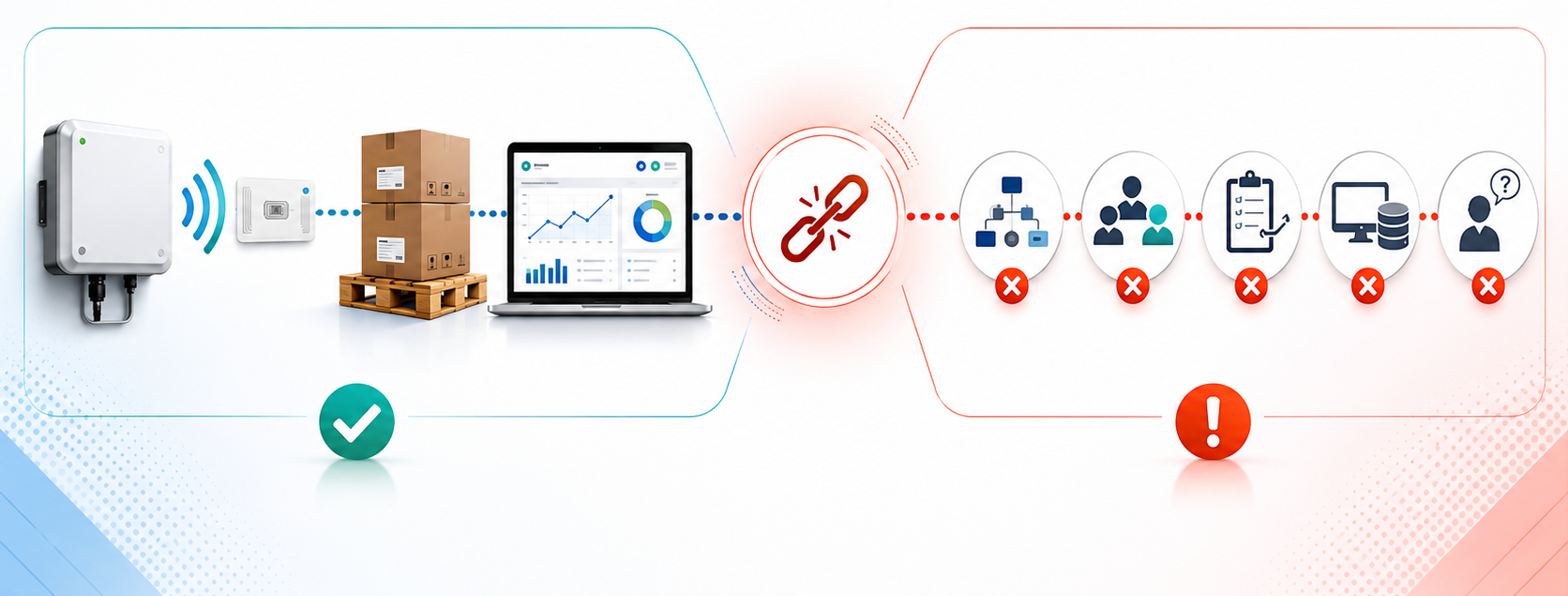
When RFID doesn’t work, the problem isn’t the technologies used. Today, readers, tags, and software platforms are perfectly capable of doing what they’re designed to do: identify objects, track their movement, and quickly obtain timely and relevant data. In most cases, in fact, what does not work is the way in which the organization is prepared to integrate unique radio frequency identification into its operational flows.

In the absence of defined processes, properly trained people, and clear accountability in system management, RFID does not work. When these conditions are present, however, RFID becomes an extremely powerful tool.
The unambiguous automatic identification is not enough to make the data usable
RFID allows you to automatically record the passage of objects, materials or assets along operational activities. In the case of the factory, it does so from the entry of the goods to their handling in the warehouses up to production, supporting operators both in inventory checks and in shipments. However, for these records to become reliable data on which to base operational decisions, it is necessary that the tracked information is associated with clear processes, consistent inventory management and operational practices applied continuously by the teams that use the technology.
In other words, RFID functions as a unique identification infrastructure, but it does not automatically produce order, reliability, or discipline in business processes. Automation makes operational steps visible and generates data continuously, but the quality of that information depends on how the process is designed and governed. To understand in more detail when RFID does not work, it is necessary to take a closer look at how and why it is grafted into operational processes.
Ambiguous processes: when the RFID read does not match a defined operational event
RFID is used in many operational contexts.
- In logistics, it allows you to track raw materials, components and finished products, pallets and load units along all storage and handling flows.
- In production, it allows materials and semi-finished products to be followed in the different phases of the production lines, supporting not only the picking phases but also kitting and fitting activities. RFID tags help manufacturers protect products and consumers from the risks of counterfeiting and the gray market.
- In the world of distribution, tags are used to facilitate the availability, handling and positioning of items to optimize warehouse inventories, oversee stocks and avoid out-of-stock, speeding up orders and reorders more efficiently.
- In healthcare, RFID supports the traceability of medical devices, clinical equipment, drugs, blood bags, and biological samples along the routes of use and administration, improving patient safety, inventory management, and storage condition control.
- In asset management, using smart-labeled labels with RFID allows you to identify and monitor any company asset (machinery, tools, components, folders, and so on) along their use cycle
In all these areas, RFID is perfectly capable of reading tags and recording the physical passages of objects throughout the supply chain. The critical point is that each reading must correspond to a clearly defined operational event. Which means asking yourself the right questions about what it means to implement RFID technology in your organization:
- When can an object be considered really taken over by the system?
- What step certifies that a task has been completed?
- How are exceptions or intermediate situations that require testing or auditing handled?
In other words, each RFID read must be associated with an operating rule that establishes which status must be updated in the system and at what point in the process.
RFID reads without operational match
The problem arises when the technology correctly records a step, but the process does not determine what operational effect it should have on the management system.
For example, if the process does not functionally determine when the material becomes available in stock and who needs to validate the status, the system can show goods received but not usable, or the opposite. The reading is not wrong: it is the operational meaning of the event that remains undetermined. Therefore, in order for these readings to become truly usable, it is necessary for the operational flow to establish precisely what each reading must attest.
The same applies to shipping: a pallet can be read near the bay, but not yet have been loaded onto the vehicle or not be correctly associated with the shipping mission. If it is not defined which step certifies the true output, the WMS records events that are radio-consistent but inconsistent for the process. When these rules are not explicit, the system can record technically correct steps but continue to produce inconsistent states at the management level.
A similar dynamic can also be observed in infrastructure monitoring: RFID sensor/tag detection can be correct, but if it is not connected to a signaling system with defined thresholds, activation conditions and responsibilities, the system records the data and can generate reports that are not related to clear operational criteria. In the absence of rules on when an event should become an alert and how it should be managed, alerts accumulate without effectively supporting control and operational intervention. In these conditions, the detection is there, but it does not contribute to the management and prevention of critical issues.
Inconsistent inventory: when the RFID data does not match the real state of the assets
RFID can make proper detection, but it cannot compensate for dysfunctional operating practices. Under these conditions, it is not RFID that does not work, but the way in which read data is used to govern operations. Here are some concrete examples:
- Returns in a pending state
A recurring example is the management of returns: the goods return, are read and physically placed in a quarantine area, but remain waiting without a clear flow of requalification and return to stock. As the days go by, the system accumulates suspended statuses and reconciliation becomes manual. Here RFID does not lack reading: it is the inventory consistency that degrades.
- Manual inventory realignments
Another typical scenario concerns manual realignments. To unblock operations, system corrections are made (such as displacements or stock adjustments) without intervening on the cause that generated the discrepancy. The effect is that physical and digital diverge cyclically and trust in the data drops rapidly.
- Assets without usage responsibilities
A similar dynamic can also be observed in the management of assets and company assets. A piece of equipment or device can be correctly identified when it moves from one department to another, but if the movements do not follow procedures for taking charge and updating responsibility for the asset, the asset register progressively loses reliability. The technology continues to read the tag, but the system can no longer determine with certainty where the object is, who is using it or what its operational status is.
In these scenarios, the gap between physical reality and the management system tends to reappear, progressively eroding the trust of operators in the available data. When personnel return to manual audits for safety, the value of Radio Frequency Unique Identification is dramatically reduced. In mature projects, the true threshold of quality is not only the percentage of reading, but the continuity with which any change in stock or asset status is recorded and governed according to consistent and shared procedures throughout the process.
Operational discipline: when the technology is there but the routine does not hold up
The third factor that determines the effectiveness of an RFID project concerns the continuity with which the system is used in daily activities. Automatic identification requires precise and repeatable operating routines over time: verification procedures, systematic recording of passages and structured management of anomalies. In many projects, critical issues emerge precisely when these routines are not applied continuously. Some recurring examples:
- Warehouse: Exception management and inventory checks In warehouses, this translates into activities such as periodic inventory checks performed as often as expected, use of handheld terminals at established process points, and timely exception handling. If a gate does not read a quota of packages, the procedure involves re-passing, scanning with a portable terminal and closing the event in the system. When these operations are postponed or handled informally, discrepancies begin to accumulate over time.
- Production: discontinuous traceability of semi-finished products In production lines, the same dynamic concerns the passage of materials between the different phases of the process. If the readings at the transition points are not taken regularly, the traceability of the semi-finished products loses continuity and the system can no longer accurately reconstruct the path of the components along the line
- Fixed assets and assets: unrecorded transfers Similar situations occur in the management of assets and company assets. Tools, equipment, or devices can be correctly identified by the system, but if movements between departments or construction sites are not recorded with consistent procedures, the location and responsibility for use of objects becomes progressively less reliable.
The operating conditions to prevent RFID from not working
When operational routines are applied discontinuously – scans performed only in certain phases, anomalies left open, checks postponed – the quality of the data progressively degrades and the system loses reliability in the eyes of the operational team. In contexts where RFID generates real value, on the other hand, its use is integrated into the daily standard work and is supported by clear responsibilities and indicators that measure the continuity of operational behaviors.
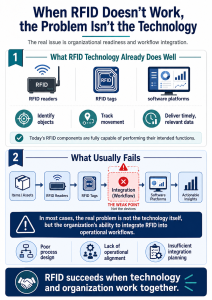
Unique radio frequency identification is very reliable in identifying objects and recording their passages along operational activities and it is true that in some limited applications its adoption can also be very rapid. However, when RFID is used to govern complex operational processes, each reading must have a precise meaning in the operational process. It should be clear which step generates the event, what status needs to be updated in the system, and how exceptions should be handled.
For this reason, in AutoID projects that really work, we always start from the analysis of organizational processes, defining the rules by which objects change state in management systems and the procedures with which anomalies must be verified and resolved. Only then can the reader, tag, and software architecture be sized correctly.
Here is where Inventag Team could help: to face and overcome these challenges by selecting best technology according to business needs.
WANT TO KNOW MORE ?
Stay tuned on inventag.it and our LinkdIn page.
For any further information our Inventag Team is glad to help: write us at info@inventag.it


